CRS Full Form in Engineering: What It Stands For
In engineering document control, CRS stands for Comment Resolution Sheet — the register that tracks every comment raised during review of an engineering deliverable and records how each one was closed. On an engineering document, a drawing transmittal, or in a design review workflow, that is what the abbreviation means.
The word "engineering" is doing real work in that sentence, because CRS is an overloaded abbreviation. Before assuming, check which of these you are actually looking at.
CRS Is Not Always the Comment Resolution Sheet
| Where you saw it | What CRS most likely means |
|---|---|
| Design review, transmittal, document control, EDMS | Comment Resolution Sheet |
| Civil / survey / GIS data, map projections, coordinate files | Coordinate Reference System |
| Mechanical drawings, material specs, bar stock | Cold Rolled Steel |
| Structural or reinforcement callouts (e.g. "T16 @ 200 CRS") | Centres — bar spacing |
| Rail engineering | Clearance Requirements Standard or operator-specific usage |
The rest of this article covers the first one: the comment resolution sheet used in engineering design review. If you arrived looking for coordinate reference systems, this is not that CRS.
What a Comment Resolution Sheet Does
An engineering deliverable — a calculation, a P&ID, a general arrangement drawing, a datasheet — is issued for review. Reviewers raise comments. Without a register, those comments live in email threads, PDF markups, and meeting notes, and there is no reliable way to answer "is this document clear to approve?"
The CRS makes that answerable. Each comment becomes a numbered row that stays open until the reviewer who raised it agrees it is resolved. Approval is then a consequence of the register, not an opinion about it.
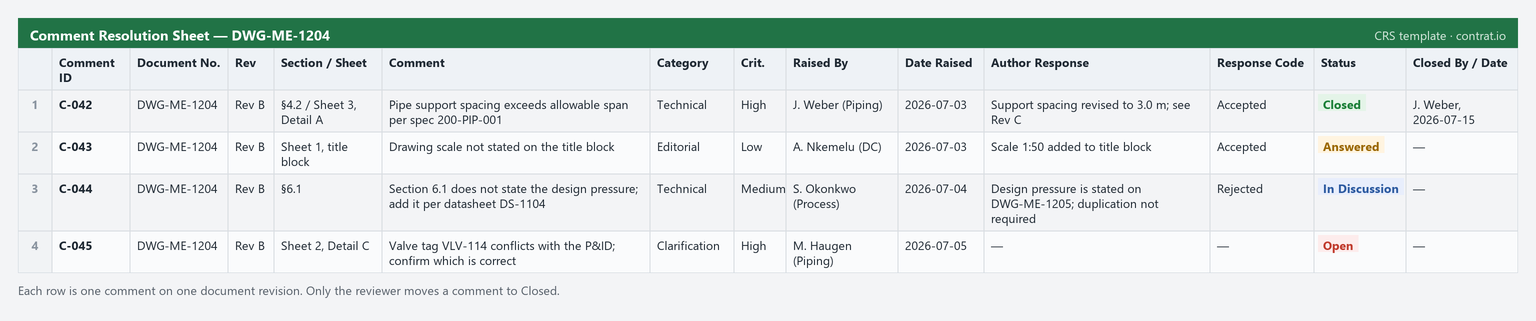
A CRS row: permanent comment ID, document and revision, reviewer, comment, author response, and a status only the reviewer can close.
What Goes on a CRS in an Engineering Document
- Comment ID — permanent. It must survive the next revision, or you lose the thread.
- Document number and revision — which deliverable, at which issue, the comment was raised against.
- Reviewer and discipline — who raised it, and from which engineering discipline's perspective.
- Comment — the substance, written so someone outside the meeting can act on it.
- Author response — what was changed, or the technical justification for not changing it.
- Status — open, responded, closed. Only the reviewer moves a row to closed.
- Severity or category — separates a code compliance issue from a drafting preference. Not every comment is a hold point.
CRS in Civil Engineering Specifically
Civil and infrastructure projects are where the abbreviation collides most often, because both meanings are in daily use: the design team runs a comment resolution sheet on deliverables, while the survey and GIS data carries a coordinate reference system.
They are unrelated, and context separates them cleanly. A CRS with a comment ID column is a review register. A CRS written as "EPSG:27700" or "WGS 84" is a projection. If a document mentions both, expect the coordinate reference system to appear in the datum or georeferencing notes and the comment resolution sheet to appear in the review and approval workflow.
How It Fits the Wider Review Process
The CRS is one layer of engineering document control. Around it sit the review codes reviewers assign to a document as a whole (A, B, C, and D response codes), the suitability codes that govern what a document may be used for (ISO 19650 status codes), and the review cycle itself. For the end-to-end process, see What Is a Comment Resolution Sheet?; for a starting file, there is a free CRS Excel template; and for what rows look like per discipline, see Comment Resolution Sheet examples.
When the Spreadsheet Stops Scaling
A CRS in Excel is fine on a small deliverable set. It degrades once you have several disciplines reviewing, multiple revisions in flight, and comments that need to carry forward — because at that point the sheet's integrity depends entirely on someone manually enforcing rules the file cannot enforce itself.
Contrat.io enforces them: permanent comment IDs across revisions, role-based closure so an author cannot close their own comment, automatic carry-over of open items to the next revision, and an audit trail that holds up when a claim depends on it. Free for 30 days, no credit card required.
Frequently Asked Questions
What is the full form of CRS in engineering?
Comment Resolution Sheet — the register used to track and close review comments raised against engineering deliverables such as drawings, calculations, datasheets, and specifications.
What does CRS stand for in civil engineering?
Both Comment Resolution Sheet and Coordinate Reference System are common in civil engineering, and they are unrelated. In a design review or document-control context it is the comment resolution sheet; in survey, mapping, or GIS data it is the coordinate reference system.
What is CRS in an engineering drawing?
In the review workflow around the drawing, it is the comment resolution sheet that tracks comments raised on it. Written inside a structural or reinforcement callout, "CRS" instead means centres — the spacing between bars.
Is CRS the same as an RFI?
No. An RFI is a question asked because information is missing or unclear. A CRS row is a comment raised against a deliverable that has been issued for review. An RFI seeks information; a CRS comment seeks a correction or a justification.
Who closes comments on a CRS?
The reviewer who raised the comment. The author responds and revises, but only the reviewer may mark a row closed. If authors can close their own rows, the register stops being evidence of anything.